My Garage
My Account
Cart
Genuine Toyota T100 Vapor Canister
Fuel Vapor Canister- Select Vehicle by Model
- Select Vehicle by VIN
Select Vehicle by Model
orMake
Model
Year
Select Vehicle by VIN
For the most accurate results, select vehicle by your VIN (Vehicle Identification Number).
6 Vapor Canisters found
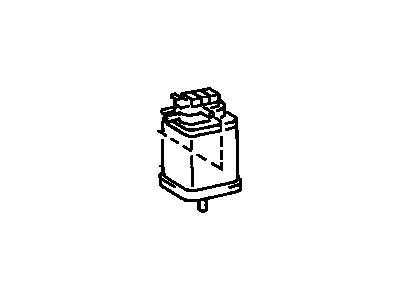
Toyota T100 Charcoal Canister Assembly
Part Number: 77740-34070$245.21 MSRP: $351.62You Save: $106.41 (31%)Ships in 1-3 Business DaysToyota T100 Charcoal Canister Assembly
Part Number: 77740-34071$245.21 MSRP: $351.62You Save: $106.41 (31%)Ships in 1-2 Business Days
Toyota T100 Vapor Canister
The Vapor Canister in Toyota T100 is an EVAP assembly that include a Vapor Canister used in controlling Hydrocarbon (HC) emission in the environment. This cylinder commonly called charcoal canister traps fuel vapors, with activated charcoal, which has tiny pores for storing the fuel vapors until they are required by engine. This component is then linked with the fuel tank and the carburetor so that the releasing of the vapors into the engine for burning is regulated. Evap systems have since been developed over the years, OBD II vehicles now have what is known as the canister vent solenoid and the fuel tank pressure sensor to indicate the development of leaks to affecting emissions control.
If you are in demand for superior quality and affordable OEM Toyota T100 Vapor Canister, then shop with us! We own a wide range of the reduced-priced genuine Toyota T100 Vapor Canister. You can purchase in confidence as all parts come with a manufacturer's warranty. Any issues with our products? No need to worry as we have a hassle-free return policy to guide you every step of the way.
Toyota T100 Vapor Canister Parts Questions & Experts Answers
- Q:What is the function and maintenance process for the evaporative emission control system and Vapor Canister on Toyota T100?A:This system is intended to capture an accumulating fuel that comes from fuel tank, throttle body and intake manifold and which by right should not be released to the atmosphere as the fuel is composed of hydrocarbon. The early evaporative emission control systems entail a charcoal canister, linking lines, coolant temp sensor, a vacuum switch valve, the ECM, a check valve on the canister and some of the later models involved a Vapor Pressure Sensor that is usually installed on the engine bay. The charcoal canister is installed under the vehicle near the fuel tank starting from the models of 2003 and 3.4 L V6; the vapor pressure sensor is used to detect leakage within the system. It accumulates fuel vapors in the canister if the engine is switched off and releases the same to be burnt in the engine if the engine is on. The canister contains of the check valve that has two balls, which depend on fuel tank pressure to regulate airflow. Problems like poor idle, stalling and driveability are some of the problems that can result from a bad check valve, a damaged canister or bad hoses. Crystal droplets or smell of fuel may call for checking the fuel lines or the canister for crack and kinking of hoses. In case fuel has spilled out from the canister it should be replaced and the related hoses examined for damages. Cracks on the canister surface can be observed, and a clogged filter or stuck check valve can be checked using low pressure air. The vacuum hoses should be identified and disconnected for canister replacement, then the mounting clamp bolts must be loosened and the hoses disconnected and the same procedure must be reversed for fixing.