My Garage
My Account
Cart
Genuine Toyota Supra Throttle Body
Fuel Injection Throttle Body- Select Vehicle by Model
- Select Vehicle by VIN
Select Vehicle by Model
orMake
Model
Year
Select Vehicle by VIN
For the most accurate results, select vehicle by your VIN (Vehicle Identification Number).
15 Throttle Bodies found
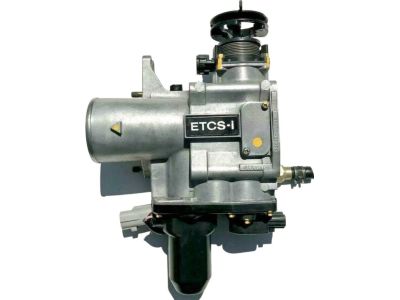
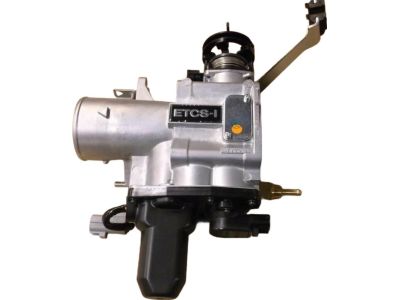
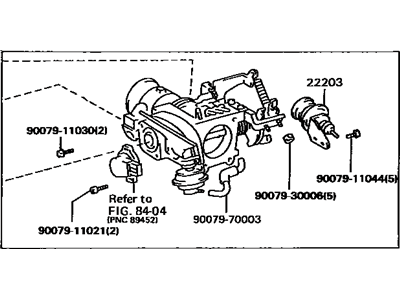
Toyota Supra Throttle Body Assembly
Part Number: 22030-46120$497.39 MSRP: $742.01You Save: $244.62 (33%)Ships in 1-3 Business Days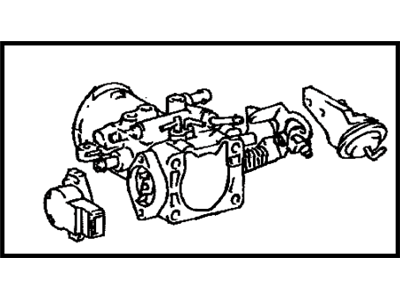
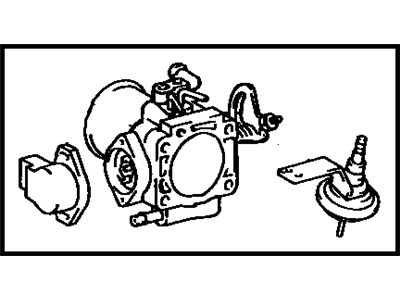
Toyota Supra Throttle Body
Supplying air to the engine is what the Toyota Supra Throttle Body does depending on how far the driver pushes down the accelerator. Placed between the air filter housing and the intake manifold is the Throttle Body. It has a butterfly valve in it that opens when you press the pedal. This allows more air to enter the engine. The sensors then signal the powertrain control module, which in turn increases the length of the pulse width of the injector. The Throttle Body has a shaft that carries a valve and connects to a throttle position sensor. The Throttle Body has a bypass passage that feeds the idle air control (IAC) valve so that idle speed is stable. The Toyota Supra intake path airflow, vacuum, and pedal data is processed by the control module commanding the fuel delivery. Many of the models use electronic throttle control. Here, the Throttle Body has an electric motor, which responds to the pedal sensors. Moreover, it does not have any mechanical cable. Thus, it reduces linkage problems. When the mileage is high, wear of the shaft or carbon deposits inside the Throttle Body will result in a rough idle. The problem will either require cleaning or full replacement of the Toyota Supra system. The Toyota system guarantees perfect balance between air and fuel at differing engine conditions in Supra.
If you are in demand for superior quality and affordable OEM Toyota Supra Throttle Body, then shop with us! We own a wide range of the reduced-priced genuine Toyota Supra Throttle Body. You can purchase in confidence as all parts come with a manufacturer's warranty. Any issues with our products? No need to worry as we have a hassle-free return policy to guide you every step of the way.
Toyota Supra Throttle Body Parts Questions & Experts Answers
- Q:How to check and perform the removal and installation of the throttle body on Toyota Supra?A:Verify that the throttle linkage moves freely. Start the engine and allow it to idle. Detach each vacuum line from its respective port and note whether vacuum is present or not; open the throttle a little and note again whether there's vacuum present. Compare your observations to the accompanying tables for throttle body vacuum lines on 1979 through 1981 models, ensuring that the "8," "6," and "*" stamped onto the throttle body next to each port match up with the same number on the line when reattaching. If a line fails to indicate vacuum when it should, remove the throttle body, clean it thoroughly, and re-check it. If the numbers on the vacuum lines aren't visible, mark them with pieces of numbered tape before detaching them. Drain the cooling system and disconnect the battery ground cable, taking caution if the stereo is equipped with an anti-theft system before detaching the cable. Clearly label, then disconnect any hoses from the intake duct, remove the bolts from the bracket that attaches the duct to the valve cover, loosen the large hose clamps, and disconnect the intake air duct. Detach the accelerator cable rod from the throttle linkage and disconnect the TV cable if applicable. Clearly label, then detach the coolant hoses and vacuum sensor hoses, remove the four retaining bolts, and detach the throttle body and gasket from the air intake chamber. Clean the throttle bore and check for cracks in the body and obstructions in the ports. Check the throttle valve for smooth operation and the throttle valve shaft for excessive play, ensuring there's no clearance between the stop screw and throttle lever when the throttle valve is completely shut. The throttle position sensor should be checked and adjusted. Installation is the reverse of removal, ensuring all air, coolant, and vacuum hose connections are tight, followed by refilling the cooling system and checking for leaks.