

My Garage
My Account
Cart
Genuine 1987 Toyota Supra Fuel Tank
Gas Tank- Select Vehicle by Model
- Select Vehicle by VIN
Select Vehicle by Model
orMake
Model
Year
Select Vehicle by VIN
For the most accurate results, select vehicle by your VIN (Vehicle Identification Number).
2 Fuel Tanks found
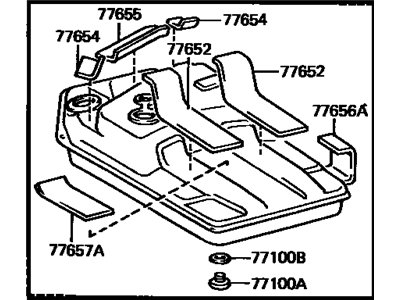 Product Specifications
- Part Name Code: 77100
- Item Weight: 29.20 Pounds
- Item Dimensions: 37.7 x 31.0 x 12.2 inches
- Condition: New
- Fitment Type: Direct Replacement
- SKU: 77001-19425
- Warranty: This genuine Toyota part is covered by warranty.
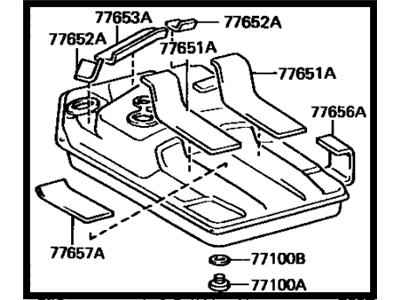 Product Specifications
- Other Name: Fuel Tank
- Part Name Code: 77100
- Item Weight: 29.20 Pounds
- Item Dimensions: 37.0 x 31.3 x 11.8 inches
- Condition: New
- Fitment Type: Direct Replacement
- SKU: 77001-19426
- Warranty: This genuine Toyota part is covered by warranty.
1987 Toyota Supra Fuel Tank
With ToyotaPartsDeal.com, you have access to an extensive inventory of genuine 1987 Toyota Supra Fuel Tank, all priced competitively. Feel secure in your purchase, as all our OEM 1987 Toyota Supra Fuel Tank are covered by warranty. Plus, we offer a hassle-free return policy and speedy delivery service.
1987 Toyota Supra Fuel Tank Parts Questions & Experts Answers
- Q:How to properly remove and reinstall a fuel tank for the 1987 Toyota Supra?Posted by Ziimaa G.A:Relieve the pressure in the fuel system and disconnect the cable from the negative terminal of the battery. To improve access when working underneath the vehicle, raise the rear end and support it securely on jackstands while blocking the front wheels. Unscrew the drain plug and empty any remaining fuel into an approved fuel container before removing the tank. Pull back the carpet in the luggage compartment, remove the access cover for the fuel level sender unit, and unplug the electrical connector. Disconnect the fuel inlet pipe flange from the fuel tank. Clearly label and then disconnect the fuel outlet, return, and vapor recovery hoses, noting that the outlet hose is the largest in diameter, the return is smaller, and the vapor recovery hose is the smallest. Support the fuel tank with a transmission jack or a floor jack, placing a piece of wood between the jack pad and the tank for protection. Disconnect the tank mounting bands and carefully lower the tank a few inches, ensuring all electrical connectors for the fuel level sender unit or the in-tank fuel pump are disconnected before removing the tank from the vehicle. Installation is the reverse of removal, using a new seal gasket for the sender unit and a new gasket for the fuel filler pipe attachment. Replace any defective or suspect hoses, ensuring that hose and pipe connections are in good condition and secure. Tighten the mounting band retaining nuts securely, then reconnect the fuel level sender unit and fuel pump electrical connectors before reattaching the battery ground cable. Refill the fuel tank and check for any signs of leaks from the tank or from the pipe and hose connections.Answered by Toyota Parts Specialist Jerry / Nov 09, 2025
Related 1987 Toyota Supra Parts
 1987 Toyota Supra Fuel Filter
 1987 Toyota Supra Fuel Pump
 1987 Toyota Supra Fuel Pressure Regulator
 1987 Toyota Supra Gas Cap
 1987 Toyota Supra Fuel Door Release Cable
 1987 Toyota Supra Fuel Tank Strap
 1987 Toyota Supra Fuel Door
 1987 Toyota Supra Fuel Filler Neck