

My Garage
My Account
Cart
Genuine 2010 Toyota Prius Axle Shaft
Car Axle Shaft- Select Vehicle by Model
- Select Vehicle by VIN
Select Vehicle by Model
orMake
Model
Year
Select Vehicle by VIN
For the most accurate results, select vehicle by your VIN (Vehicle Identification Number).
2 Axle Shafts found
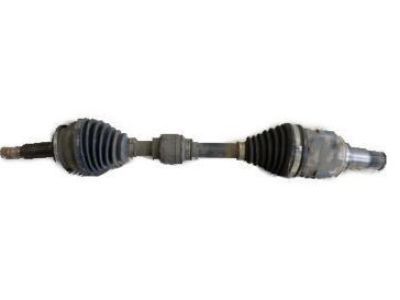
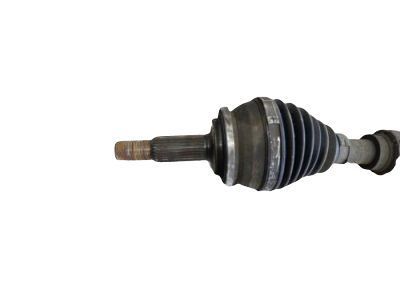
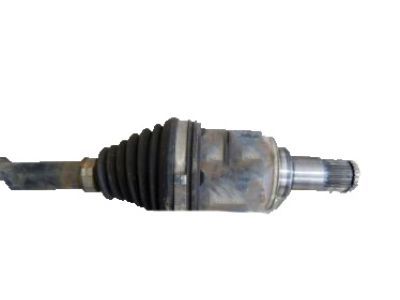
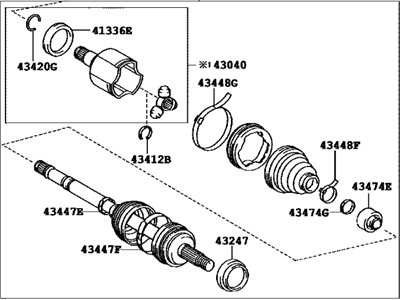
2010 Toyota Prius Front Drive Shaft Assembly Left Hand
Part Number: 43420-47030$297.38 MSRP: $452.96You Save: $155.58 (35%)Ships in 1-3 Business DaysProduct Specifications- Other Name: Shaft Assy, Front Drive, Lh
- Position: Driver Side
- Replaced by: 43420-47031
- Part Name Code: 43420
- Item Weight: 15.20 Pounds
- Item Dimensions: 30.1 x 7.4 x 6.6 inches
- Condition: New
- Fitment Type: Direct Replacement
- SKU: 43420-47030
- Warranty: This genuine Toyota part is covered by warranty.
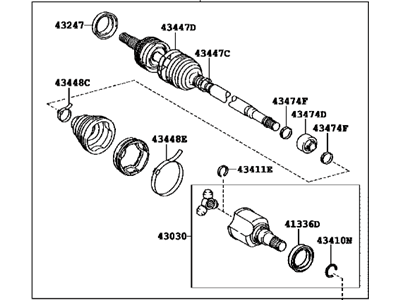
2010 Toyota Prius Front Drive Shaft Assembly Right Hand
Part Number: 43410-47030$345.23 MSRP: $521.57You Save: $176.34 (34%)Ships in 1-3 Business DaysProduct Specifications- Other Name: Shaft Assy, Front Drive, Rh
- Position: Passenger Side
- Replaced by: 43410-47031
- Part Name Code: 43410
- Item Weight: 15.20 Pounds
- Item Dimensions: 30.7 x 7.5 x 6.5 inches
- Condition: New
- Fitment Type: Direct Replacement
- SKU: 43410-47030
- Warranty: This genuine Toyota part is covered by warranty.
2010 Toyota Prius Axle Shaft
With ToyotaPartsDeal.com, you have access to an extensive inventory of genuine 2010 Toyota Prius Axle Shaft, all priced competitively. Feel secure in your purchase, as all our OEM 2010 Toyota Prius Axle Shaft are covered by warranty. Plus, we offer a hassle-free return policy and speedy delivery service.
2010 Toyota Prius Axle Shaft Parts Questions & Experts Answers
- Q:What are the key functions, maintenance procedures, and symptoms of worn or damaged axle shafts and CV joints for the 2010 Toyota Prius?Posted by Meg S.A:The power is taken from the transaxle to the wheels through driveshafts; the inner ends clip into the gears of the differential while the outer ends are splined to the axle shafts and held in place by a large nut. The inner ends consist of sliding constant velocity joints on the tripod bearing with the ability to provide angular as well as axial movement. Since the axle shaft moves with the wheel, it also has joint housing for sliding movement. The joints can be unbolted and removed for cleaning if a boot is worn out though if the parts are permanently damaged one has to do a complete change. There are outer CV joints that include ball bearing between inner race and outer cage; these joints only permit angular movement and therefore; it means that these joints must be cleaned and inspected but should not be disassembled; If damaged it is replaced together with the axle shaft. Particularly, the inspection of the boots, in order to ascertain that they are not torn and the lubricant is not leaking out of it, is recommended on a regular basis since torn boots can cause joint injury. Replacing boots usually involves axle shaft pulling out; however, there is a type of boots that are split and used conveniently without pulling out the axle shaft. However, to maintain the cleanness and to eliminate any chances that contaminants might fasten the wearing out process, it is safer to remove the axle shaft and clean the CV joint. There are signs that show that the CV joints are worn out or damaged and they include the following; The lubricant leaks, and the vehicle has a clicking sound when turning, the vehicle makes a clunk sound when it is accelerated after coasting and the vehicle vibrates at high speeds. To assess wear, grip an axle between your hands, and while holding the CV joint housings, try to rotate it, as it should have a feeling of tightness; if the splines are worn or the joints are loose, you will feel it: visually inspect the axle shaft for cracks, dents, and distortion.Answered by Toyota Parts Specialist Jerry / Feb 02, 2026


